
 By
By 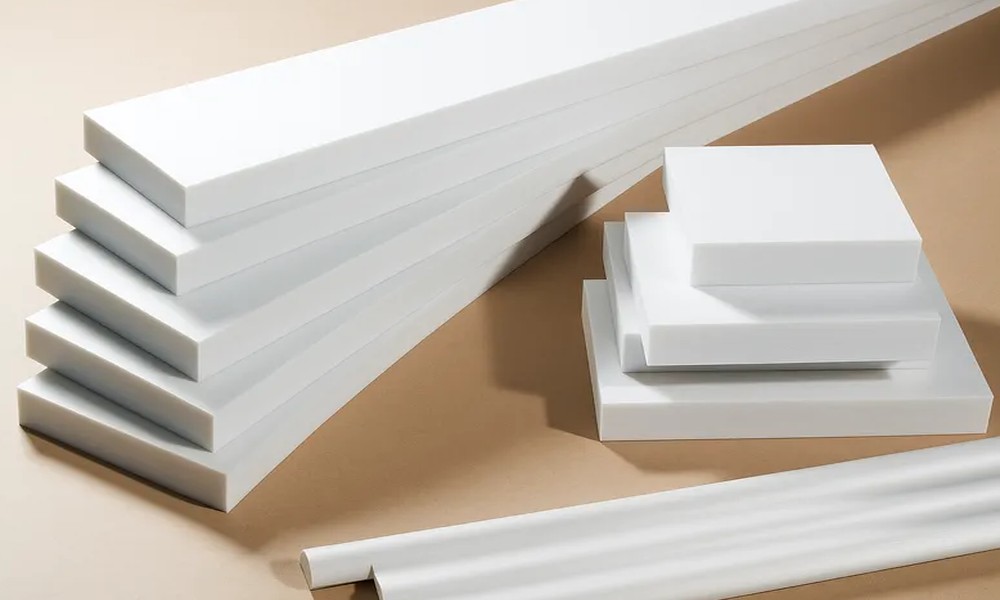
At a Glance:
- PTFE delivers outstanding chemical resistance, making it ideal for environments involving corrosive acids, solvents, and aggressive industrial fluids.
- Its naturally low friction and self-lubricating behaviour reduce heat, wear, and energy loss in moving machinery.
- PTFE remains stable at high temperatures and during thermal cycling, helping protect equipment from deformation.
- Its electrical insulation and long-term dimensional stability make PTFE a dependable choice across demanding industrial applications.
PTFE (polytetrafluoroethylene) is one of the most versatile engineering plastics used in industrial environments. It performs consistently better than metals, rubbers, and other plastics, making it a reliable material for manufacturing, processing, and heavy industrial use.
What sets PTFE apart is the way its structure behaves under harsh conditions. It resists chemical attack and remains stable at high temperatures, and delivers exceptionally low friction.
This article breaks down the key reasons PTFE performs well in demanding environments and explains how each property supports real-world performance.
Exceptional Chemical Resistance for Harsh Environments
PTFE’s chemical resistance is one of the primary reasons it excels in industrial applications. Its non-reactive structure prevents damage from corrosive chemicals, strong acids, solvents, and harsh industrial fluids. This stability allows engineers to use it in harsh, corrosion-prone environments.
Components such as seals, gaskets, valve seats, and pump parts are made from PTFE to protect their integrity against chemical attack and extend service life. This reduces downtime, lowers leakage risk, and helps plants maintain safe, reliable operation.
Low Friction and Self-Lubricating Performance
PTFE has one of the lowest friction coefficients of any solid, making it a reliable choice for industrial wear-resistant applications. The low-friction behaviour allows components to move smoothly, even under continuous load or repetitive motion.
Unlike many plastics that require lubrication, PTFE naturally self-lubricates, providing consistent performance from installation. It is well-suited for bearings, bushings, slide pads, and other moving elements used in PTFE engineering-plastic assemblies. The equipment made with PTFE experiences less heat buildup, uses less energy, and wears down more slowly.
High Temperature Stability Across Operating Conditions
PTFE is widely used where operating temperatures may reach up to approximately 260°C. It keeps its shape, strength, and performance with repeated temperature changes. This thermal stability also prevents common issues like deformation and brittleness.
In industries like chemical processing, thermal treatment, or high-temperature sealing, PTFE’s resistance to warping and breakdown ensures consistent operation.
Excellent Electrical Insulation Properties
PTFE is also valued for applications requiring strong electrical insulation. Its high dielectric strength and low electrical conductivity make it ideal for systems that require reliable insulation, protecting sensitive components from electrical failures.
Thanks to its ability to resist chemicals, moisture, and heat, PTFE maintains reliable insulation. It is commonly used in wiring systems, cable insulation, semiconductor manufacturing, sensors, and equipment exposed to harsh industrial conditions.
Moisture-Resistant and Dimensionally Stable
Its hydrophobic surface resists water absorption, swelling, and degradation in humid or chemically aggressive settings. This feature maintains dimensional stability over time, which is critical for parts that require tight tolerances or long maintenance intervals.
Because PTFE’s moisture resistance protects components from distortion and premature wear, industries rely on it for linings, coatings, seals, and insulation. Such long-term stability enhances reliability in applications that require sealing integrity or dimensional accuracy.
PTFE offers chemical resistance, low friction, thermal stability, electrical insulation, and long-term dimensional reliability, which allows it to withstand harsh conditions with predictable results. Together, these strengths make PTFE a reliable choice for many industrial applications.
If your industry involves chemical exposure or elevated temperatures, a trusted engineering plastics supplier can help you select the right PTFE grade for long-lasting performance.











Comments